Always Compliant, Always Ready: Mine's End-to-End DROP Solution

For organizations that fall under California's DELETE Act, August 1st marks the start of a new operational reality - a continuous cycle that repeats every 45 days, indefinitely.
Understanding the requirements is one thing.
Having a platform that handles them for you is another.
We recently hosted a webinar, “DROP Compliance, End-To-End: A Live Mine Product Walkthrough”, showcasing exactly how Mine operationalizes DROP compliance: from initial data preparation through automated request processing, suppression management, reporting, and audit readiness.
Here is what operational DROP compliance actually looks like, and what becomes possible when the platform handles it for you.
Instant Data Clarity
The best DROP implementations start with a clear picture of what data your organization holds and where it lives. Mine makes this significantly easier.
DROP organizes consumer identifiers into lists: Email, Phone number, Name+Date of birth+ZIP, MAID, TVID+Name, and VIN. Organizations register only for the lists that match identifiers they actually store.
Getting this right from the start avoids wasted effort and ensures every workflow is grounded in your real data landscape.
Mine's data classification module does the heavy lifting here. It scans databases, cloud storage, SaaS platforms, and communication systems to surface exactly which types of identifiers exist and where.
Privacy teams get a clear, evidence-based view of which DROP lists they need to register for, without manual investigation across dozens of systems.
The result is a faster, more accurate starting point, and a data map that continues to deliver value well beyond DROP, supporting DSR workflows, vendor governance, AI governance, and broader privacy operations.
Fully Automated, Every 45 Days
DROP compliance follows a repeating cycle: pull requests from CalPrivacy, match them against your data, act on the results, and report back. Mine is built to handle every stage of that cycle automatically.
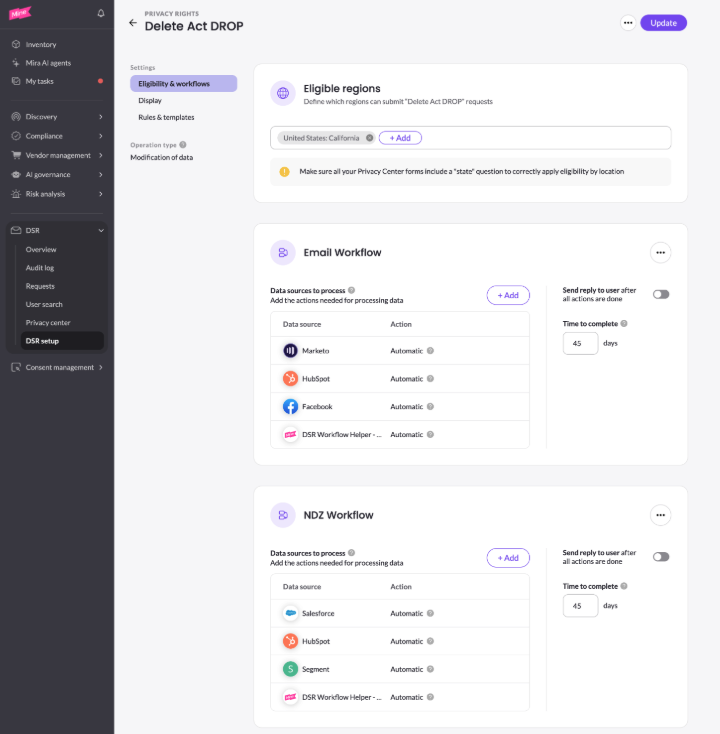
Organizations configure separate workflows for different identifier types, such as email addresses or phone numbers, ensuring each request is processed only to the systems that store that identifier.
When a new batch is available, Mine's DROP integration pulls it via the CalPrivacy DROP API, and runs them through a customer-hosted hash-to-identifier lookup service, which matches incoming hashes to the corresponding identifiers stored in internal systems. Matched identifiers are routed directly into Mine's DSR workflow engine, where deletion is triggered across connected systems, according to each identifier’s workflow.
Unmatched identifiers are automatically logged to the managed suppression list. Results are continuously reported back to CalPrivacy as processing progresses, keeping the DROP workflow synchronized.
You can configure what is the DROP cycle that suits you, from a daily cycle up to a 45-day cycle. Daily cycles of pulling-processing-reporting keeps batches small and reduces risk.
Everything Covered in One Platform
What makes Mine's DROP solution powerful is the depth of coverage across every part of the compliance lifecycle.
Setup is straightforward. A dedicated DELETE Act DROP right is configured directly in the platform, scoped to serve only California residents, set to the 45-day SLA, and with consumer-facing communications disabled.
This right is kept hidden from the public privacy center, so data subjects cannot submit DROP requests manually, but only through the DROP platform.
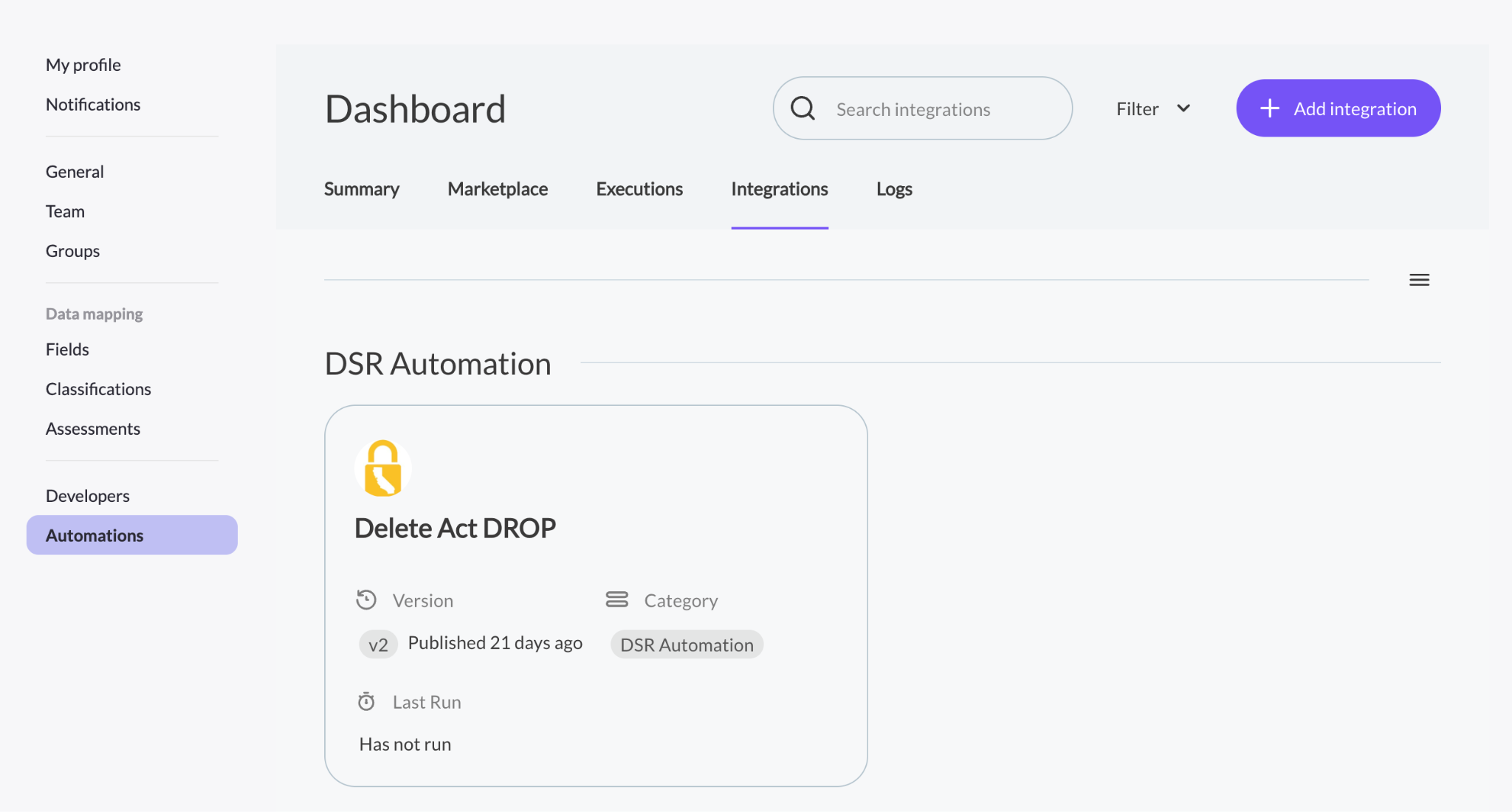
From there, Mine's autopilot capability takes over for day-to-day operations. Every step that would otherwise require manual action, running integrations, orchestrating deletions across systems, closing tickets, and submitting reports, is handled automatically.
For privacy teams managing high volumes of requests across complex data environments, autopilot transforms DROP compliance from a labor-intensive process into a hands-off operation.
Mine also supports the full range of response types required by the DELETE Act: deleted, exempted, opted out, and not found.
For situations where a matched identifier corresponds to more than one individual, a separate opt-out workflow can be configured to handle those requests appropriately.
Suppression You Can Rely On
One of the most important capabilities Mine offers for DROP compliance is managed suppression, and it goes significantly further than a static list.
Every identifier pulled from DROP, whether matched or unmatched, is automatically logged to Mine's suppression list.
This helps organizations meet the DELETE Act's ongoing obligation by ensuring deleted consumers remain suppressed across future data ingestion - from enrichment platforms, marketing data, partner files, or any other third-party source.
Mine's suppression list is PII-free by design. Only hashes are stored, never the underlying personal data.
It is built to be actively integrated into your data infrastructure: accessible via API, direct database connection, or BigQuery view, and connectable to downstream marketing and data platforms so that suppression changes propagate automatically to the systems that need them.
When a previously unmatched identifier is later excluded from an ingestion pipeline, Mine captures that change, updates the suppression record, and reports the exclusion back to CalPrivacy as a deletion, because under the DELETE Act, exclusion counts as deletion.
Audit-Ready by Default
Mine is designed so that audit readiness is a byproduct of normal operations, not a separate effort.
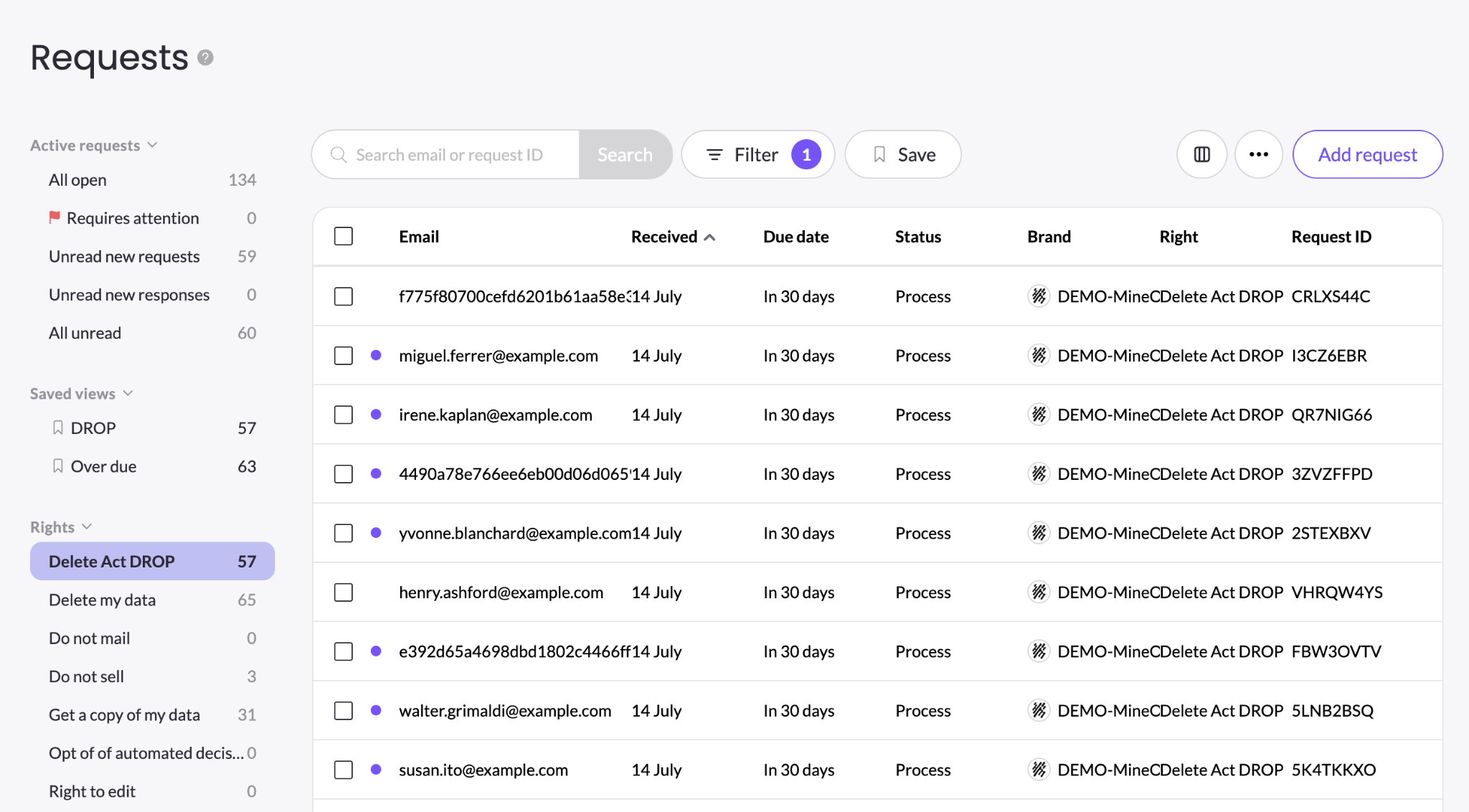
Every DROP request processed in Mine generates a complete record: the original hash, the matched plain identifier, the workflow it was routed through, the systems involved, the outcome, and a full timestamp trail.
Organizations can add custom fields to capture anything additional their audit requirements demand. Nothing needs to be reconstructed after the fact.
The suppression list provides the same depth of record for every identifier that passes through the DROP cycle, including resolution status, batch source, and the last time the record was updated.
CalPrivacy has recommended retaining these records for seven years, in anticipation of required third-party audits. With Mine, organizations begin building that history from the moment they go live, so they are always prepared, not just compliant.
See It Live
Mine is the only end-to-end privacy and AI governance platform built to operationalize DROP compliance fully: from data classification and identifier matching to automated deletion orchestration, suppression management, reporting, and audit-ready recordkeeping.
Privacy teams get a platform that handles the full cycle automatically. Engineering teams get clear integration points and managed infrastructure. And organizations get the confidence of knowing every 45-day cycle runs reliably, at scale, with a complete record of everything that happened.
Schedule a demo to see DROP compliance in action.
Related Stories



Ready to build your own autonomous kingdom?
Ready to build your own autonomous kingdom?