AI Governance Finally Has the Missing Context: Agent Posture Meets GRC

AI agents are rapidly becoming part of everyday business operations - but governing them hasn't kept pace.
Traditional security tools discover AI activity. Governance platforms understand business risk. Every AI agent introduces a new operational identity with its own permissions, data access, decision-making capabilities, and relationships across the business:
For CISOs, every new agent expands the organization's attack surface.
For GRC teams, every new agent introduces new governance decisions, compliance gaps, and policy risk.
Unlike traditional software, AI agents aren't introduced through a centralized procurement process. They're created by employees, teams, and developers across the organization, making visibility, ownership, and governance dramatically more difficult.
The challenge is not just discovering AI. It's understanding which AI agents expand your risk surface and which can be trusted inside your organization.
That's why we built AI Agent Posture Management: to discover the AI actually running across your endpoints, understand its technical and business posture, and turn that context into clear governance action.
Understand Which AI Agent Deserves Your Attention
Every organization has hundreds, if not thousands, of AI agents.
The challenge isn't just discovering them. It's also understanding their behavior and knowing which ones deserve your attention.
Mine deploys a lightweight sensor to employee endpoints which continuously discover AI agents, skills, LLMs, tools, MCP servers, and related AI assets across the organization. The sensor reports what is actually running on each endpoint, giving security teams complete visibility into how AI is being used across the business.
The sensor gives teams visibility into what is actually installed and running across employee endpoints, including understanding the agents behavior. That endpoint-level context turns AI discovery into an actionable risk intelligence platform.
Visibility is only the starting point. Security teams need to understand where risk exists, what deserves immediate attention, and what can be confidently approved.
Want to see this in action?
Watch the recording of our live walkthrough of Mine’s AI Governance platform to see how to identify which AI agents pose risk, understand why, and take the right governance action next.
Posture Changes the Conversation
Security teams already know how to evaluate software risk.
They rely on software inventories, SBOMs, dependencies, CVEs, identities, permissions, OAuth scopes, exposed secrets, network exposure, and third-party risk to understand the security posture of applications.
Those signals remain essential.
AI agents introduce another layer of operational risk that technical controls alone cannot explain.
An agent may have no known vulnerabilities, approved permissions, and secure authentication, yet still introduce significant business risk because it accesses regulated data, violates internal AI policies, interacts with unapproved vendors, or makes autonomous decisions without oversight.
This is where AI discovery ends - and Agent Posture Management begins.
Every discovered AI agent is continuously evaluated using the governance context security teams already rely on to manage organizational risk.
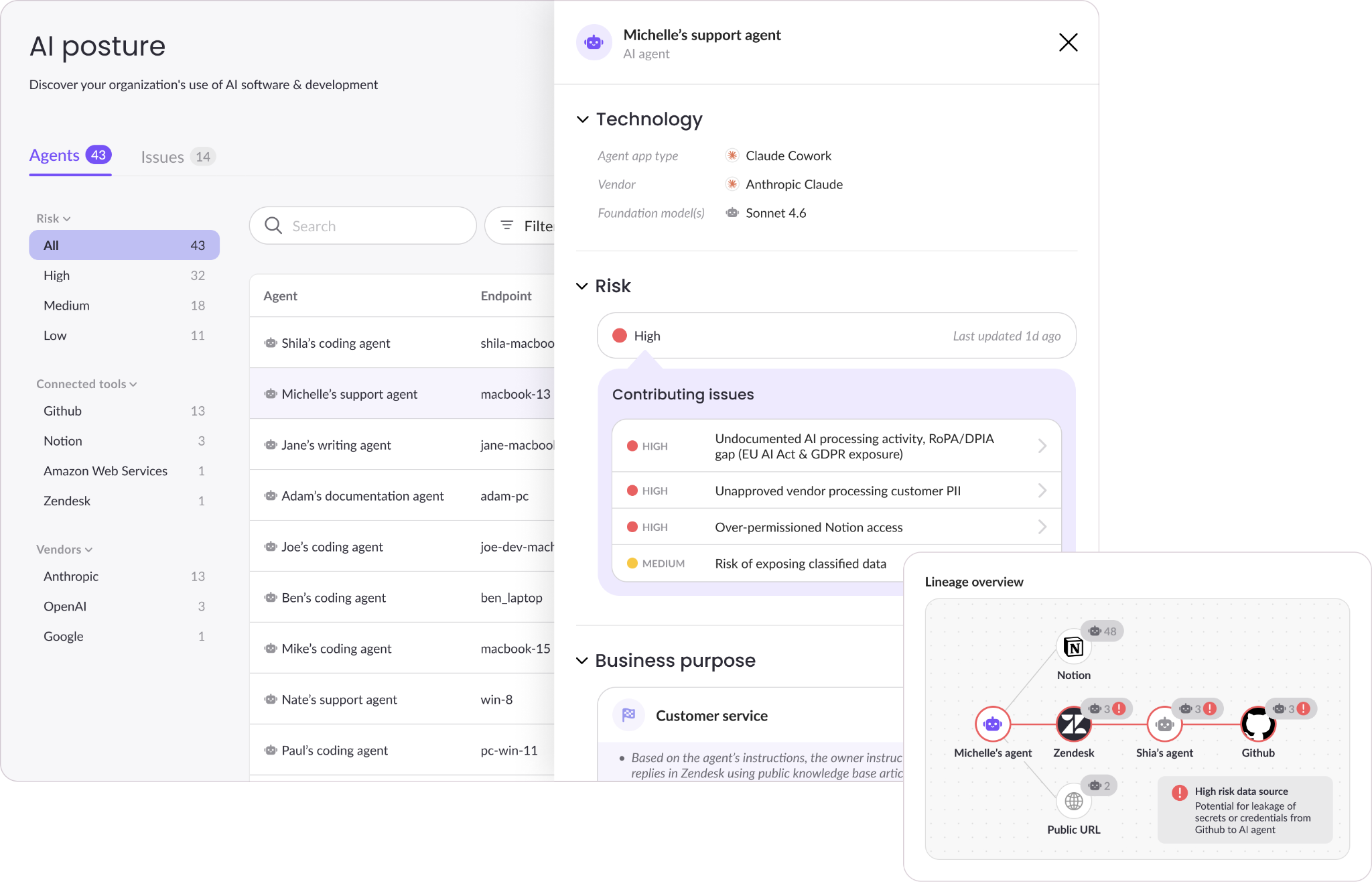
Mine combines endpoint discovery with the GRC context security teams already rely on to govern risk. Each agent is evaluated across its configuration, connected tools, sensitive data access, vendor relationships, assessments, processing activities, business purpose, ownership, and lineage - giving security teams a clear view of both technical posture and business risk.
That continuous posture drives governance actions - helping teams assess and approve agents, prioritize remediation, monitor changes, and enforce AI policies based on organizational risk.
Instead of asking What AI agents exist?, CISOs can answer the questions that drive real governance.
- Which AI agents have access to regulated data?
- Where are unapproved vendors introducing AI risk?
- Which autonomous workflows violate internal AI policies?
- Which AI can be confidently approved?
- Where is business risk accumulating across connected agents?
Mine also classifies AI agents by business purpose, helping teams understand where AI is being used across the organization and identify areas that may require additional oversight.
Agent Lineage Reveals the Risk You Can't See
Security teams have spent years securing software supply chains because they understand that risk rarely exists within a single application. It emerges through relationships, dependencies, and third-party services.
AI introduces an entirely new execution model - one where agents invoke other agents, activate tools, access data, and trigger autonomous workflows across the business.
A single AI agent may invoke another agent, connect to multiple MCP servers, retrieve sensitive documents, call external APIs, interact with SaaS applications, and trigger downstream workflows before completing a single task.
Looking at one agent in isolation only tells part of the story.
The real risk lies in what happens next.
That's why lineage alone isn't enough. Security teams also need the governance context that explains whether that execution path violates policy, reaches regulated data, or introduces unacceptable third-party risk.
An agent with limited permissions can become high risk because of the systems it activates, the sensitive data it reaches, or the vendors and models it relies on.
Mine combines agent lineage with GRC context to expose how risk moves across AI agents, business systems, third-party vendors, and sensitive data. This gives security teams a connected view of each agent's dependencies and relationships, so they can trace where an agent's access originates, what it can reach, and where that creates governance or business risk.
Govern AI with Confidence
AI adoption will continue to accelerate across every business function.
The organizations that lead won't be the ones that simply discover the most AI agents. They'll be the ones that understand which agents can be trusted, which require oversight, and which should never reach production.
By combining AI discovery, GRC intelligence, agent lineage, and automated governance, Agent Posture Management gives security leaders the continuous understanding they need to stay ahead of AI risk while accelerating responsible AI adoption.
Every AI agent has a posture. The organizations that understand it will be the ones that lead AI adoption securely.
Ready to see Agent Posture Management in action?
Schedule a demo and See how Mine helps security teams discover, assess, and govern AI agents using the GRC context and lineage traditional AI discovery tools can't provide.
Related Stories

Ready to build your own autonomous kingdom?
Ready to build your own autonomous kingdom?