Meet Vendor Scout: Autonomous Vendor Intelligence for Modern Governance Teams

Third parties sit at the center of every governance process.
Almost every assessment, across every team, depends on them. Launching a new product feature, introducing new software, adopting AI, or starting a new data activity all involve third parties, whether new or existing.
In practice, this understanding is built manually, vendor by vendor. Each review is limited in scope, depth, and consistency, and quickly becomes outdated.
A vendor approved today may introduce a new feature tomorrow. A system may change how it processes data. A tool may introduce a generative AI capability.
AI governance is becoming a core responsibility across organizations, but many AI capabilities are introduced through third-party vendors. When vendors add AI features, copilots, or automated decision-making capabilities, governance requirements can change overnight.
The risk changes, but the assessment does not.
The Hidden Cost of Fragmented Vendor Research
Most workflows still follow the same pattern:
- Search vendor websites
- Review trust centers
- Read privacy and security documentation
- Check certifications and subprocessors
- Copy findings into internal systems
The result is slow, inconsistent, and difficult to maintain.
Research reflects a point in time and rarely matches how the vendor is actually used. New features, especially AI capabilities, quickly make assessments outdated and reduce risk visibility.
At scale, this becomes a bottleneck.
At ~2 hours per vendor, teams spend weeks gathering and maintaining fragmented information.
General-purpose AI tools like ChatGPT can help summarize information, but they do not solve this problem:
- Sources are not always reliable or traceable
Information may come from unverified, incomplete, or conflicting sources. These AI tools are often fed from biased marketing material, rather than objective documentation - Context is missing
General AI tools lack the understanding of your organization, business processes, policies or regulatory scope and will produce generic or partial responses. - No integration with operational workflows
Insights need to be manually copied, structured, and mapped into your systems - making it harder to collaborate, track progress, and maintain consistency across teams. - No reasoning or evidence layer
Teams still need to verify findings and connect them back to source documentation.
For example:
A team asks ChatGPT to summarize a vendor’s security and privacy posture.
The response is generic. It reflects public content, often shaped by marketing language, and does not account for how the vendor is used internally.
Vendor Scout approaches the same problem differently.
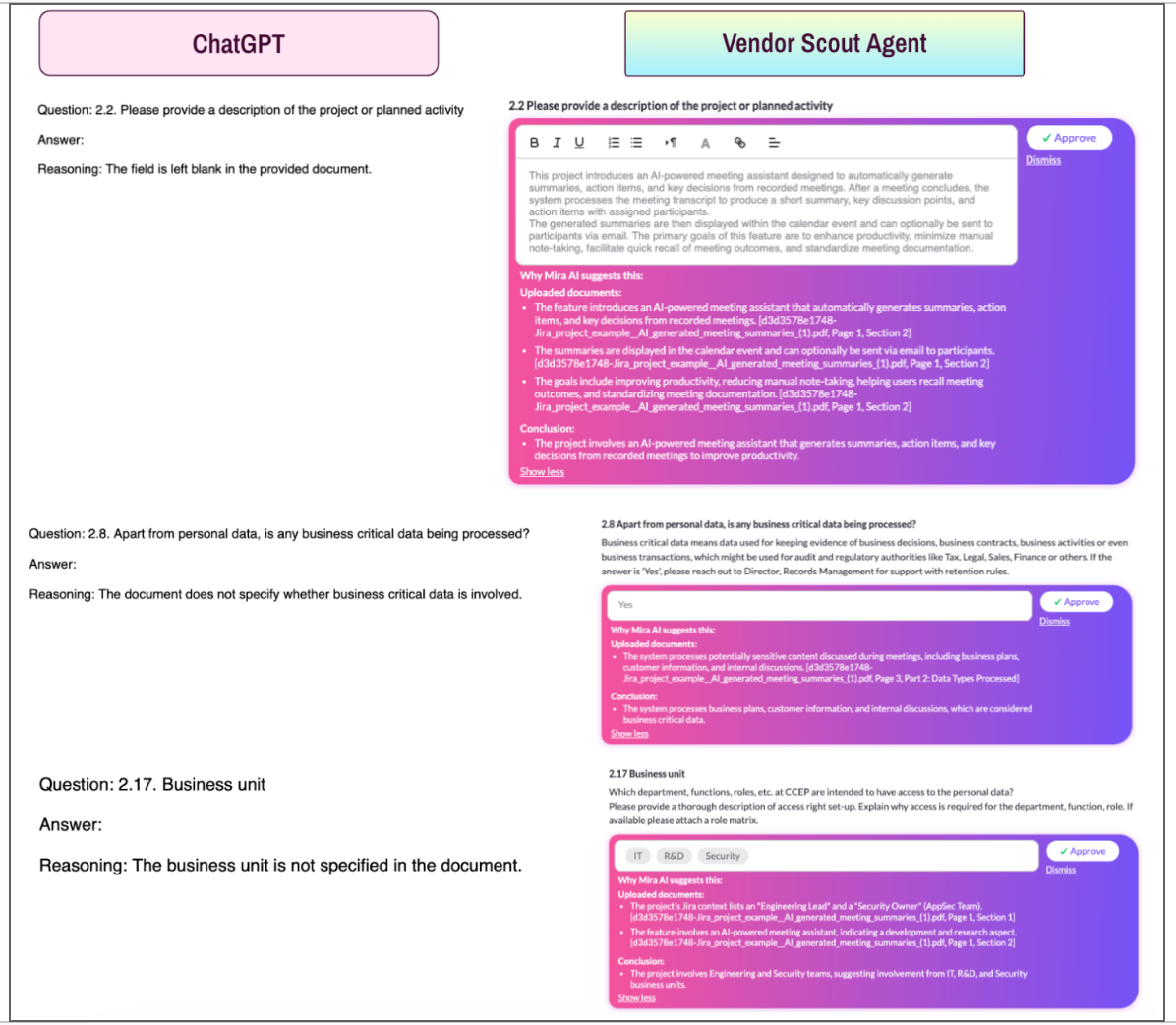
The gap is not access to information. It is the ability to structure and apply it in context.
When Vendor Risk Changes Overnight
Take a common scenario: a team approves Typeform to collect customer feedback.
At the time of approval, Typeform is used for simple surveys. The assessment focuses on data collection, storage, and access controls.
Two weeks later, Typeform introduced a new generative AI feature that analyzes responses and generates summaries or insights.
This change directly affects:
- How customer data is processed and interpreted
- Whether data is used for model-based analysis
- The level of automation in decision-making
- The associated privacy and AI risks
This is more than a vendor risk change. It creates new AI governance requirements. Organizations now need to understand whether AI is being used, what data is processed by AI systems, whether outputs influence decisions, and what governance controls apply.
But in most organizations, nothing happens.
The original assessment remains unchanged. Typeform was approved under a different set of assumptions, and the updated risk profile is never revisited.
The vendor didn’t change. The way it is used did.
This is where most governance processes break.
Vendor Scout addresses this by maintaining an up-to-date view of third-party risk as vendors evolve.
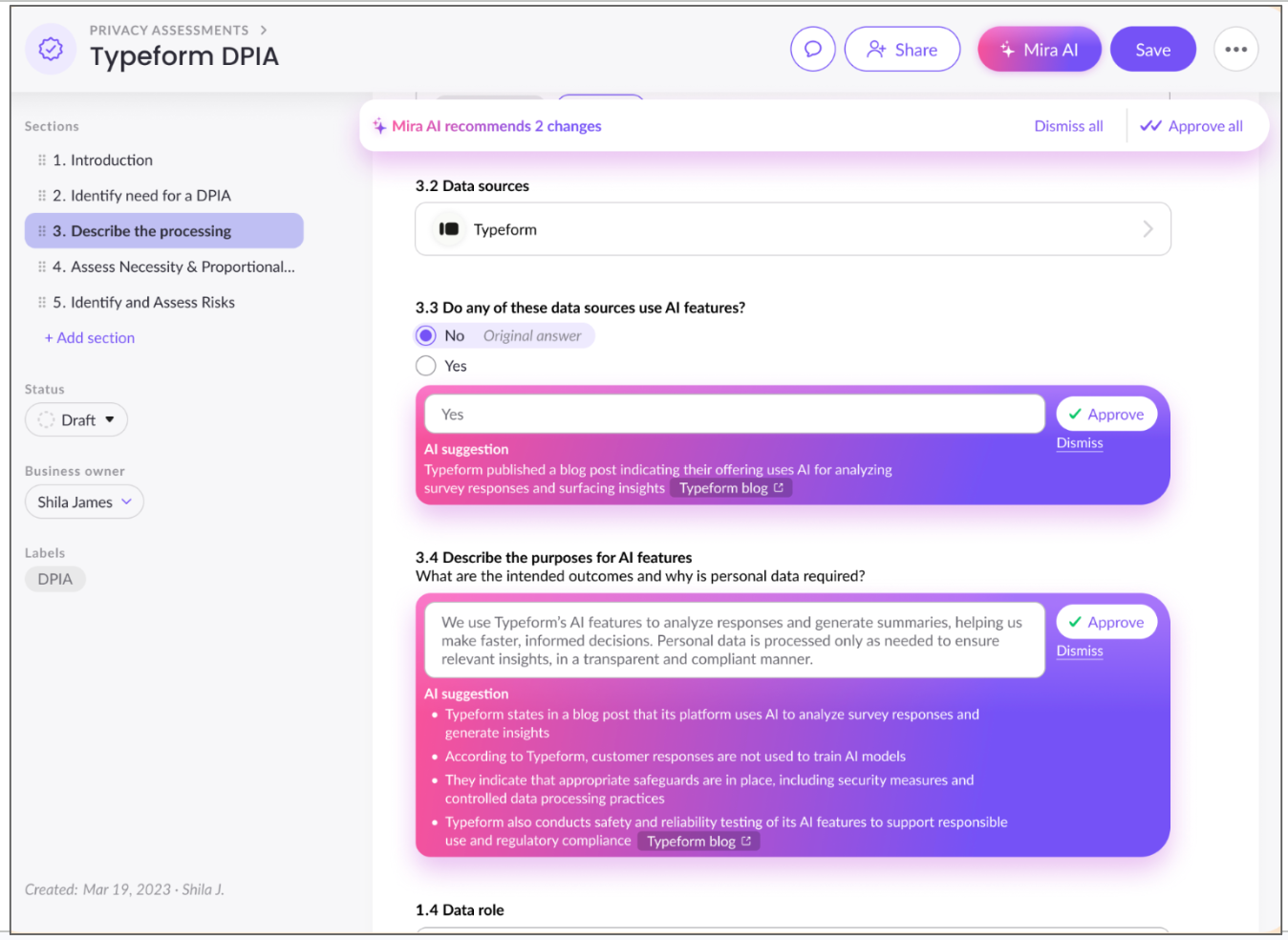
Assessments are no longer static documents. They reflect the current state of each vendor.
Introducing: Autonomous Vendor Intelligence
Vendor Scout is built to solve this gap.
It researches vendors across documents, contracts, and trusted sources, and generates structured insights before assessments begin.
It also aligns that research with your organization’s context, including how the vendor is used and what matters for your workflows.
Custom fields define what matters. Vendor Scout fills the gaps.
Vendor Scout enables:
- Replace hours of manual vendor investigation - Vendor Scout gathers vendor data from trusted sources automatically.
- Standardize vendor insights across teams - Every vendor is researched using the same intelligence framework, ensuring consistent evaluations.
- Surface deeper risk signals - Security, privacy, and compliance documentation are analyzed together to identify indicators that are easy to miss manually.
- Accelerate AI governance reviews - Automatically identify vendor AI capabilities, document AI use cases, surface governance requirements, and support AI risk assessments before AI-enabled vendors enter the organization.
The result is complete visibility into third-party risk, aligned with how vendors are actually used.
How the Vendor Scout Agent Works
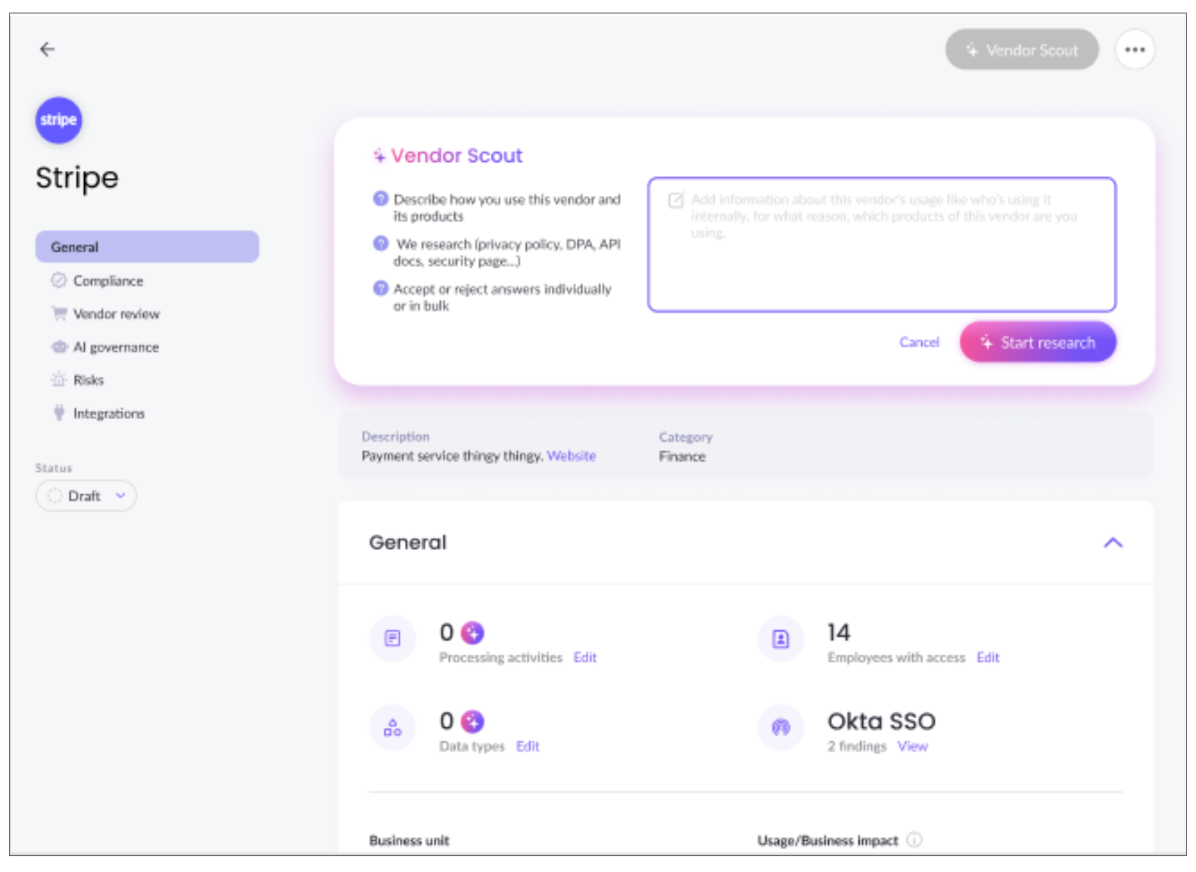
Vendor Scout combines internal context with external sources.
It analyzes existing data such as:
- Vendor domain, description and business context
- Systems and integrations
- Data types and processing activities
It then researches external sources such as:
- Trust centers and security documentation
- Contracts and DPAs
- Technical documentation
The output is structured into fields such as:
- Security certifications
- Subprocessors
- Data retention policies
- AI capabilities
- AI use cases and purposes
- AI governance indicators
- Compliance indicators
- Custom fields defined in your MineOS configuration
All suggested values are available and editable, ensuring teams remain in control of their vendor records.
Built Into Your Workflow
Vendor Scout runs inside MineOS and supports existing processes.
Teams use it during onboarding, assessments, and ongoing reviews. Insights are structured where decisions are made, without switching tools or reformatting information.
When vendors change, teams can update records as part of their workflow.
This matters because every governance decision depends on understanding third parties.
When that understanding is incomplete or outdated, risk visibility breaks down. Assessments reflect past assumptions, and decisions are made without a reliable foundation.
This is not a tooling gap. It is a structural one.
Vendor Scout addresses this by ensuring vendor insights are consistent, current, and available across workflows.
It creates a shared foundation for assessments, approvals, and ongoing governance decisions.
Bring Vendor Intelligence Into Your Workflow
Vendor Scout gives teams a complete and current understanding of their third parties, without the overhead of manual research.
It brings structure, consistency, and visibility into one of the most critical parts of any governance process.
Explore how Vendor Scout fits into your workflows and supports your governance processes.
Schedule a demo and see Vendor Scout in action.
Related Stories

Ready to build your own autonomous kingdom?
Ready to build your own autonomous kingdom?