Meet the Next-Generation Privacy Center: One Experience, Tailored to Every Request

.png)
A Privacy Center is much more than a form - it's the front door to your privacy program.
It's where customers, employees, candidates, and other data subjects go to exercise their privacy rights and manage consent. It's where privacy requests begin. And it's often one of the most visible expressions of your organization's commitment to privacy.
When someone wants to access their data, request deletion, opt out, or exercise another privacy right, the Privacy Center is often their first interaction with your privacy program. Every request, every workflow, and every privacy experience starts there.
As organizations grow, privacy operations become more complex. New brands launch. Organizations expand into new regions with different regulatory requirements. Different request types require different verification steps, supporting documents, and intake questions. Privacy teams need a request experience that evolves alongside those operational changes, not one that stays static.
That's why we're excited to introduce the new Privacy Center: a major evolution of Mine that gives organizations the flexibility to create privacy experiences that are tailored, scalable, and easy to manage, while remaining simple and intuitive for every data subject who submits a request.

Build Privacy Request Experiences Around Your Process
Privacy teams rarely receive the exact information they need in the first submission.
An opt-out request may need nothing more than an email confirmation. A deletion request may require identity verification through a government-issued ID. An authorized agent request may require supporting documentation proving authorization. Each of these should trigger a different path - not the same static form.
Until now, every data subject has faced the same Privacy Center experience, regardless of their request.
The new Privacy Center changes that.
Organizations can now operationalize privacy request intake by designing experiences that match the way their privacy team actually works.
Instead of forcing every requester through the same experience, teams can tailor the intake process to the request, the requester, and the regulatory requirements behind it.
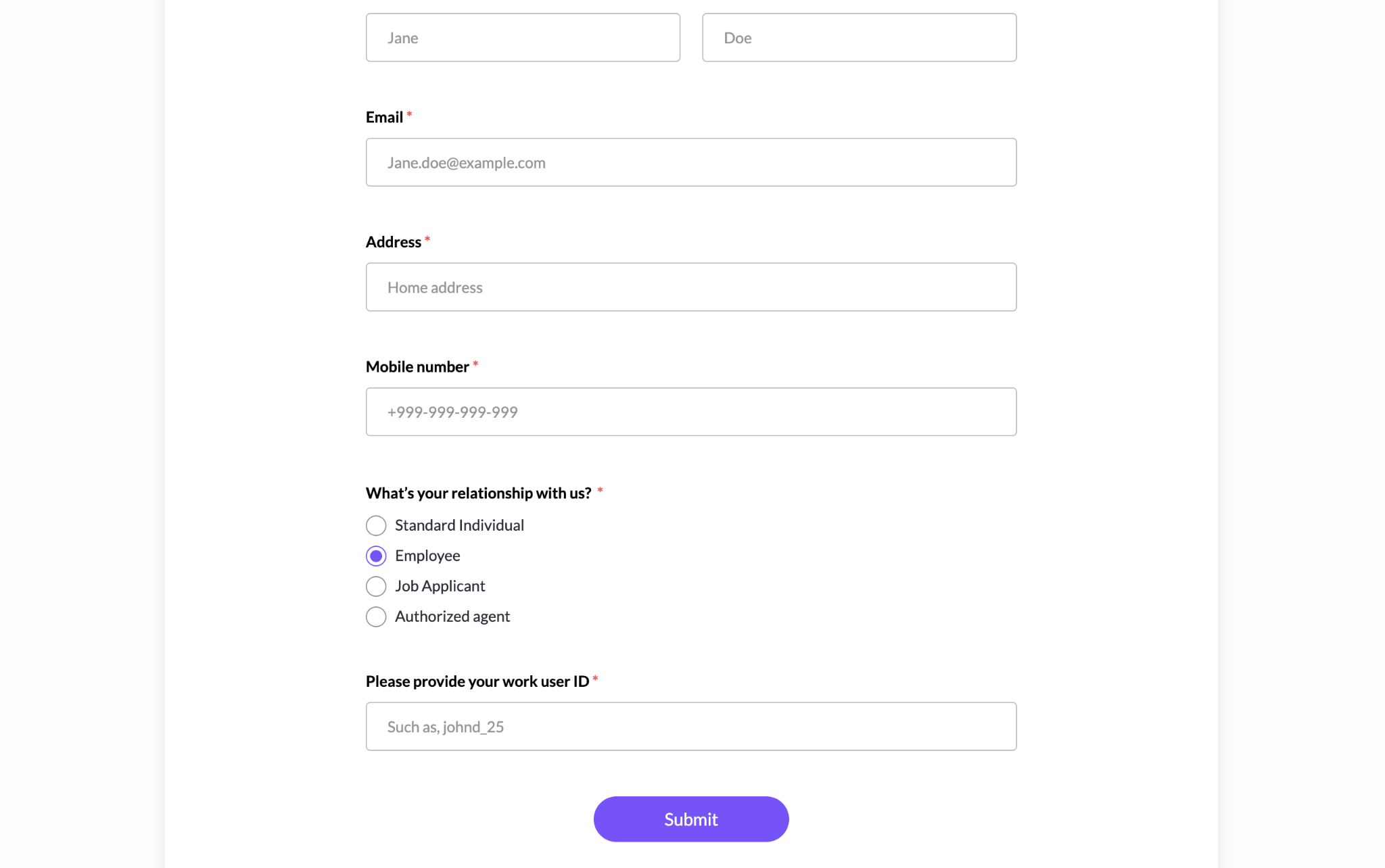
Unlike generic form builders, the new Privacy Center includes privacy-specific building blocks designed for DSR workflows. Teams can easily configure privacy rights selection, data subject relationship fields, authorized agent verification, identity verification fields, file uploads, and custom questions, all within a single experience.
Teams can also:
- Add custom questions and text fields
- Create single-select and multi-select questions
- Upload supporting documents
- Configure required and optional fields
- Reorder the request flow
- Add conditional logic between questions
- Customize the content and guidance shown to data subjects
The result is a more intuitive journey for data subjects and more complete information for privacy teams, reducing manual follow-ups and accelerating request processing.
This also matters for compliance. Manual follow-ups that slip through the cracks can delay resolution past regulatory SLA deadlines - introducing risk that’s easily avoided when the right information is collected upfront.

Scale Across Brands and Languages
For organizations managing multiple brands or global audiences, privacy request experiences need to be both consistent and localized.
As organizations expand into new markets, privacy requirements rarely stay identical. Different regions often require different privacy rights, languages, disclosures, and request flows. Supporting those differences without creating separate operational processes quickly becomes difficult.
With the new Privacy Center, each brand has its own dedicated Privacy Center - including its own configuration, branding, privacy rights display, and languages.
A privacy team can invest the time to design and perfect a Privacy Center for one brand, then use it as the foundation for additional brands. This significantly reduces setup effort while helping maintain a consistent privacy experience across the organization.
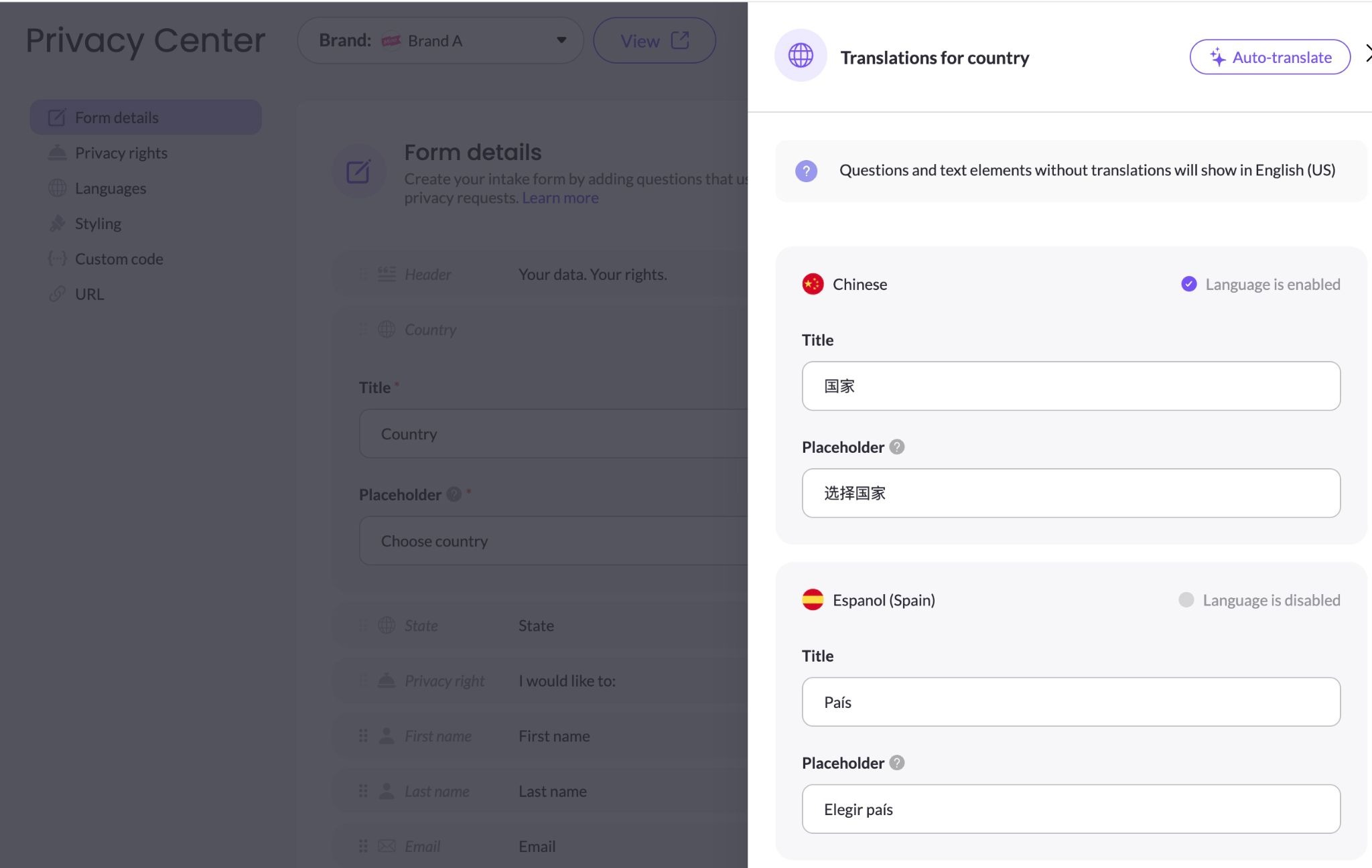
The new Privacy Center also introduces centralized translation management and automated translation capabilities. Teams can manage translations at the element level, prepare translations before making them visible, enable languages independently, and automatically translate individual fields or entire Privacy Centers in one click
Instead of manually translating every field, teams can generate translations, review and refine them internally, and publish them only when they're ready.
For example, a privacy team launching in five new markets can prepare translations in advance, review them internally, and publish them only when ready, without disrupting the live experience.
Draft, Test, Then Publish
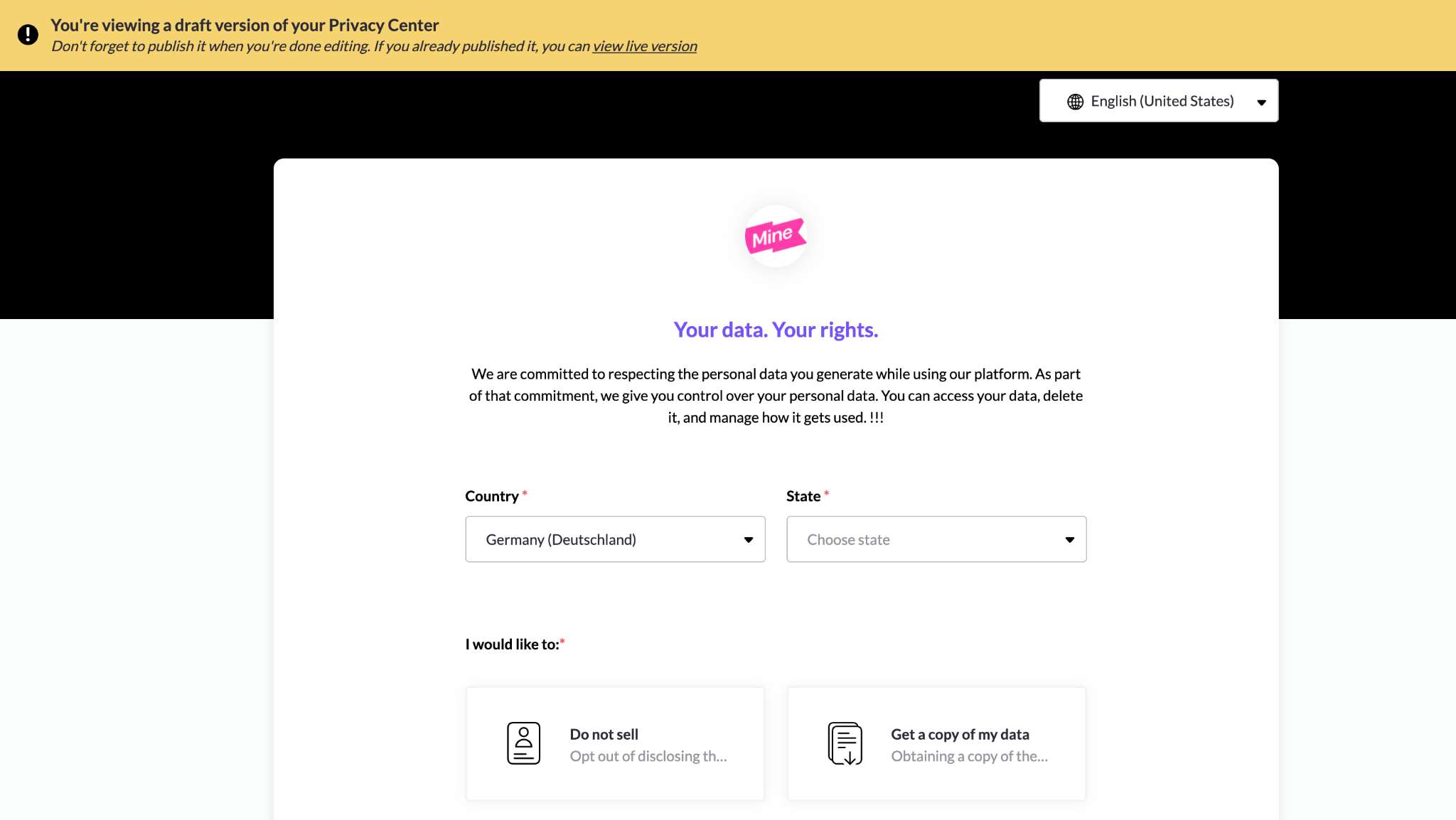
One of the most important improvements in the new Privacy Center is the ability to safely make changes before exposing them publicly. Teams can save changes as drafts, preview draft versions, compare draft and published versions, and publish only when ready.
Imagine a privacy team preparing for a new regulatory requirement. They can update the request flow, review translations, validate the experience internally, and publish only after everything has been approved.
This gives teams more flexibility to evolve their Privacy Center while maintaining control over the experience data subjects see.
The same flexibility applies to privacy rights. Teams can prepare new rights, review how they appear in the Privacy Center, and publish them only when they're ready. This makes it easier to adapt to evolving regulations while maintaining consistency between operational workflows and the public-facing privacy experience.
Privacy Request Management, Reimagined
The new Privacy Center gives privacy teams a more flexible way to manage change - whether they’re supporting multiple brands, expanding into new markets, preparing for new regulations, or collecting better information from the start.
It helps organizations create privacy request experiences that match the way they actually work, while keeping the process simple for every data subject.
Explore how your team can create privacy request experiences that scale across brands, languages, and evolving regulatory requirements, while collecting better information, reducing manual follow-ups, and delivering a smoother experience for data subjects.
Schedule a demo to see the new Privacy Center in action.
Related Stories

Ready to build your own autonomous kingdom?
Ready to build your own autonomous kingdom?